A new breast lump, persistent pain, nipple discharge or visible change needs a structured clinical assessment, not an automatic “full breast package” or reassurance based only on age. You will learn what happens from registration through examination, imaging, diagnosis and follow-up, and how to prepare useful information for the appointment.
Key takeaways
- Bring previous breast reports and mention pregnancy or breastfeeding.
- Describe when the change began, where it is, and how it has changed.
- Ask what each recommended test can show before scheduling it.
- Seek same-day care for severe symptoms, rapid swelling, or heavy bleeding.
What happens when you first register and meet the doctor
At registration, provide your main concern, age, contact details, and any previous breast reports. Tell the staff if you are pregnant, breastfeeding, or seeking help for a new lump, discharge, skin change, nipple change, or persistent pain. A breast concern checkup in Thane should begin with your history, not an automatic “full breast package.”
Before examining you, the clinician will clarify when the change began, its exact location, and whether it is on one side or both. They will ask whether it varies with your menstrual cycle, pregnancy, breastfeeding, menopause, or hormonal contraception.
- Explain your periods, pregnancy and breastfeeding history, contraception, menopause status, and medicines, including hormones and blood thinners.
- Mention previous breast lumps, infections, surgery, biopsies, implants, or abnormal mammograms and ultrasounds.
- Describe breast or ovarian cancer in close relatives, especially diagnosis at a young age, male breast cancer, pancreatic or metastatic prostate cancer, or a known BRCA-related mutation.
- Bring reports, scan images, biopsy results, and a list of medicines if available.
The clinician should also ask about fever, redness, injury, recent procedures, and nipple discharge. You can request a chaperone and ask what the examination involves before consenting. This information helps decide whether you need observation, imaging, genetic-risk assessment, or a biopsy; a core-needle biopsy provides tissue diagnosis when examination or imaging looks suspicious.
How to describe your symptom and what the examination includes
Tell the doctor exactly what changed: give the date it began, the precise spot using a fingertip or clock-face description, and whether it affects one breast or both. Explain whether pain is constant, tender to touch, or linked to your menstrual cycle.
Mention nipple discharge, inversion, skin dimpling, redness, swelling, or a lump you can feel, even if it disappears. State whether you are pregnant, breastfeeding, recently stopped breastfeeding, using contraception, or menopausal. Include medicines, previous breast surgery or biopsy, and family history of breast or ovarian cancer.
During a breast health consultation in thane, the clinical examination usually follows this sequence:
- You sit with your upper body exposed while the clinician compares breast size, shape, skin texture, redness, dimpling, swelling and nipple position.
- You raise your arms and place your hands on your hips so changes become easier to see.
- The clinician feels both breasts systematically while you are sitting, then again while you are lying down, using the pads of the fingers and noting a lump’s size, movement, tenderness and edges.
- The clinician checks the armpits and areas above and below the collarbones for enlarged lymph nodes.
The examination is done privately, and you can request a chaperone. Tell the clinician if any pressure hurts. A concerning change still deserves documentation even when you cannot feel a distinct lump.
Which tests you may need—and what each test can show
Testing is chosen from your age, finding, pregnancy or breastfeeding status, and inherited risk—not from an automatic “full package.” Clinical examination lets the doctor inspect and feel both breasts and lymph-node areas; self-awareness only helps you notice a new change and cannot rule out disease.
| Method | What it can show | How it is chosen |
|---|---|---|
| Clinical examination | A lump, skin or nipple change, tenderness, or enlarged nodes | Starts assessment; a non-palpable concern still needs review |
| Self-awareness | A new difference from your usual appearance or feel | Useful for noticing change, but routine self-examination does not replace screening |
| Ultrasound | Cysts, solid masses, and the structure of a palpable area | Usually first for a new symptom under 30 and during pregnancy or breastfeeding |
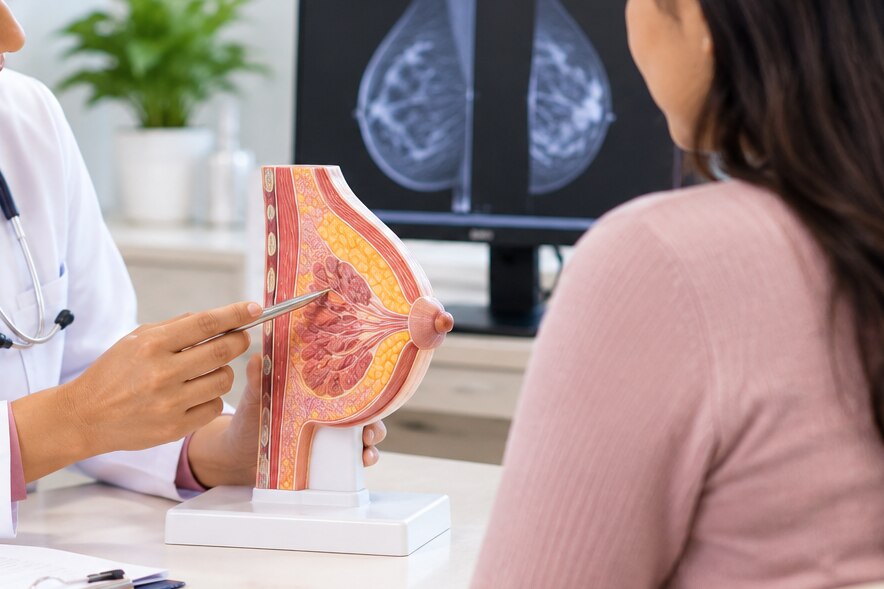
| Mammography or tomosynthesis | Calcifications and tissue patterns that ultrasound can miss | Commonly first from age 40; often paired with targeted ultrasound |
| MRI | Detailed enhancement patterns across the breasts | Reserved for selected high-risk or unclear cases; gadolinium MRI is avoided in pregnancy unless benefit outweighs risk |
Tell the clinician if you are lactating because milk changes scan interpretation. A strong family pattern, young breast or ovarian cancer, male breast cancer, pancreatic or metastatic prostate cancer, or a BRCA-related mutation can shift a women breast checkup in Thane toward genetic counselling or MRI surveillance.
Suspicious examination or imaging can lead to a core-needle biopsy, which establishes tissue diagnosis; it does not itself mean cancer is present.
When a breast change needs prompt or same-day care
A new breast lump, spontaneous bloody or clear one-sided nipple discharge, a newly inverted nipple, skin dimpling or thickening, an enlarging lump, or a lump in the armpit needs prompt medical assessment.
A breast related concerns doctor in Thane should examine these changes even when you cannot feel a distinct mass and even when you are younger than the usual screening age.
Seek same-day care for a hot, red, rapidly swollen breast with fever, chills, severe pain, pus-like discharge, or feeling markedly unwell. This pattern can indicate mastitis or an abscess, especially during breastfeeding; infection needs treatment and should not be managed by repeated self-examination.
- Bilateral aching or fullness that appears before periods and settles afterward often reflects hormonal tenderness.
- Pain in one precise area that persists beyond a menstrual cycle, worsens, or occurs with a lump needs diagnostic assessment.
- Breast pain alone is not proof of cancer, but persistent focal pain still deserves examination.
- Do not squeeze a nipple to test for discharge; spontaneous discharge is more significant than fluid produced by pressure.
| Pattern | What it may indicate | What to do |
|---|---|---|
| Cyclical, bilateral tenderness | Hormonal breast changes | Track timing and arrange review if it persists |
| Hot, red, swollen breast with fever | Infection or abscess | Seek same-day medical care |
| Persistent focal pain or a new lump | Needs diagnostic assessment | Book a timely clinical examination |
A biopsy may be recommended when examination or imaging looks suspicious. It establishes a tissue diagnosis; it does not mean cancer has been confirmed.
How diagnosis, risk assessment and follow-up are decided
The examination or scan does not provide a diagnosis by itself; the clinician matches the result with your symptoms, examination findings and personal risk. A breast concern checkup in Thane should distinguish diagnostic assessment from screening: a new lump, discharge, skin change or persistent one-sided pain needs assessment even when routine screening is not due.
A persistent change also needs review if imaging appears normal.
Risk assessment includes family patterns of breast, ovarian, pancreatic or metastatic prostate cancer, male breast cancer, unusually young diagnoses and known BRCA-related mutations. That history can lead to genetic counselling or MRI-based surveillance instead of routine mammography alone.
Choose a breast health consultation in Thane where you can leave with answers to these questions:
- Is this scan diagnostic or screening, and who will interpret it?
- If the result is benign, when should the lump or pain be checked again?
- What happens if the scan and examination do not agree?
- Do my family history, medicines or hormones change my risk?
| Finding | What it means | Likely next step |
|---|---|---|
| Benign and matches the examination | Imaging explains the concern | Reassurance, treatment or scheduled review |
| Suspicious finding | Cancer cannot be confirmed from imaging alone | Core-needle biopsy for tissue diagnosis; fine-needle aspiration may not show tissue architecture or receptors |
| Persistent or discordant change | A normal scan has not explained the symptom | Repeat examination, targeted testing or specialist referral |
Bring earlier images and reports, medicine and hormone lists, menstrual or pregnancy details, and relatives’ cancer histories. Eva Bloom Clinic can help organise that information so the consultation ends with a documented follow-up plan.
Related service
Breast Related Concerns ₹1000 For breast related problems, consult Dr. Kavita Velankar at Eva Bloom Clinic. View service → |
Frequently asked questions
What happens when I register for a breast concern checkup in Thane?
Provide your main concern, age, contact details, previous breast reports, and pregnancy or breastfeeding status. The doctor then reviews your history before deciding on an examination or test.
How should I describe a breast symptom to the doctor?
Explain when it started, its exact location, whether it is changing, and whether you have pain, discharge, skin changes, nipple changes, fever, or an injury.
Which tests may be needed for a breast concern?
The doctor may recommend an ultrasound, mammogram, or tissue sampling based on your age, examination findings, symptom pattern, pregnancy or breastfeeding status, and risk factors. Each test answers a different diagnostic question.
When does a breast change need prompt or same-day care?
Seek prompt medical advice for a new or rapidly enlarging lump, redness with fever, sudden breast swelling, bloody nipple discharge, a newly inverted nipple, skin dimpling, or severe pain. Get same-day care for severe symptoms or rapid deterioration.
How are diagnosis, risk assessment, and follow-up decided?
Your plan combines your history, examination, test findings, family history, and personal risk factors. The doctor explains whether you need monitoring, repeat imaging, specialist review, or tissue diagnosis and gives a follow-up date.
Keywords